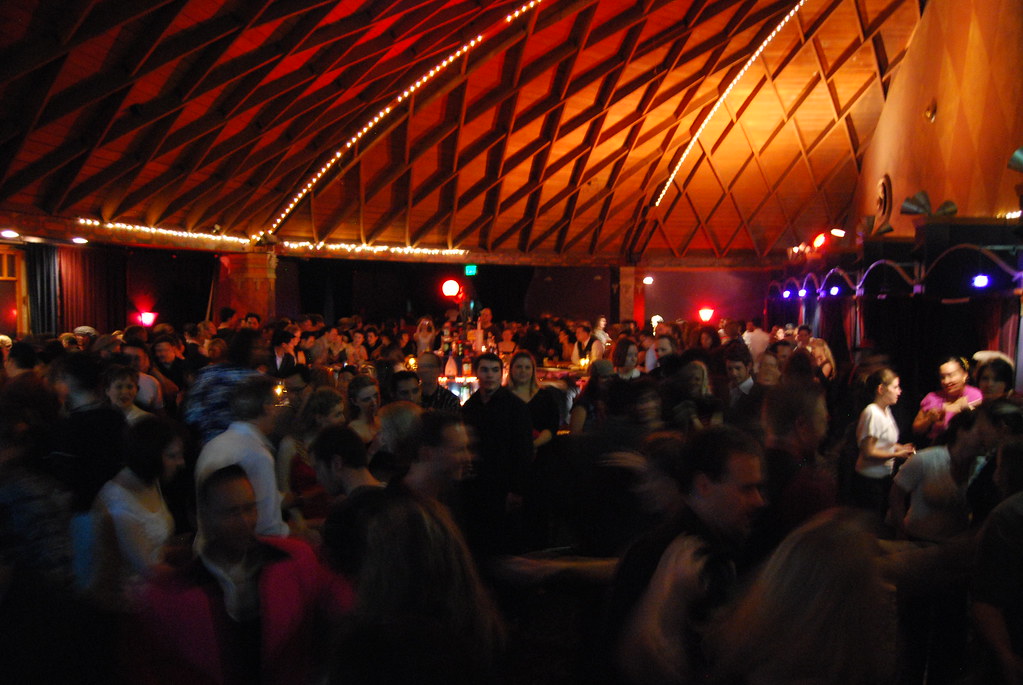
Let's start this week by congratulating everyone who participated in and donated to the
24 Hour Cancer Dance-a-thon last weekend. Over $180,000 of donations were collected for the City of Hope, which sets a record for the highest grossing donations to date. All I can say is that I'm excited for next year already.
Secondly, I'd like to plug two Lindy-centric blogs I've been reading lately:
Black Belt Lindy, by John White
Swungover, by Bobby White (no relation)
Both of the above blogs feature thoughtful consideration of the Lindy Hop. I'm especially loving John's Bruce Lee and Madd Chadd entries and Bobby's
The Old Timer series.
Okay, now on to the topic of the day. A few weeks ago, I had posted about
a school of thought that has arisen amongst some teachers that seems to suggest that counting is something that shouldn't be taught. Recently I got involved in a Facebook discussion on a similar subject. Bug Brockway asked in question of the day whether follows should count or not. I'll post here my own responses to the question:
This has been a subject of debate lately, and while it's easy to say that no dancer actually needs to learn counting, I'm leaning toward the opinion that every dancer at some point is better off for having learned the skill. I believe that all beginners can benefit from understanding numbers, and that numbers are one step towards actual listening. Others have different approaches.
An eight count is a fundamentally grounding element in dance. That is to say that if both partners have an feel for the eight, if not the down-beat, then at least they have ONE thing in common. Maybe I'm old fashioned, but I like to look for common groud with my partner and having a count (especially in the beginning) can be a key element in finding synthesis.
In the long run, we always transcend our dogma. My only care is that I and my partner find each other. Any tool I use in aid of that is worth knowing.
A few others post responses, but without permission, I'll just sum up that some folks insinuate that use of numbers might completely remove a dancer from the use of their own sensations, and others agree with my assessment of counting as a tool. Bug herself does not seem to specifically state that numbers are bad in general, and in general I think we agree that students need to let go of numbers, but this is the internet and subtlety of communication is occasionally lost. In my mind I'm talking about the argument that I've been posting here. I would imagine that on her end she's essentially suggesting things I discovered long ago, that letting go of numbers is quite important. I'm reacting to the arguments of others that numbers are bad in general:
Many students in middle school question the need to learn Algebra. If they don't ever plan to use it in future life, why will it be important to learn in the 8th grade? It's confusing and it has all these letters and maybe they weren't doing so hot with the numbers as it was. They can sort of figure out how much it costs to buy a slice of pizza. Why? It's a very common hostility that seems analogous to the arguments I've read here and elsewhere. My response to the question of why is "because it is helpful to learn to see the world in more than one way."
To me it is beyond merely helpful, it can be quite beautiful. So while it doesn't take a course in Calculus to be able to catch a ball, my understanding enriches the experience. It may not seem that way to some, but I personally find it to be true.
With regard to the dance, I have used many math and physics terms to reach my students. A student who understands vectors and momentum will have little trouble envisioning the same in their body. They still have to bridge the notion from their head through to their bodies but at least an image has begun to form for them. Other students need to physically encounter the situation. There's a different way to deal with every student. Some students are so in their head that you have to break them. Even for these students, giving them an abstraction can allow them enough comfort to trust a teacher that bit.
No, the Harlem old timers didn't count. I've heard that. I think of the developments in the time since. I've spoken to old timers who have seen what has come since. Not necessarily the Harlem old-timers on this subject but other folks who were around in the period. There are old-timers who believe the dance has gone so far beyond what the originators have done. I believe it too. I'll never stop thanking the originators for their primal gift. That said, I know I can feel, and I'm not them. The world of Lindy Hop is still growing and changing and evolving. That's something beautiful to me.
As for improvisation, as long as I've studied it, numbers have never gotten in the way. The first key to real communication is saying "yes." The second step is expanding upon that.
The numbers vs. no-numbers thing is starting to remind me of the Savoy-Hollywood mess. A lot of dogmatic rhetoric. No, strictly speaking no dancer needs to count. Yes, in a very true way, every dancer must learn to feel. If I were to boil down my statements, I would say that not only are numbers and feeling not mutually exclusive, they can actually enhance each other to a very real extent.
...
Connect-the-dots is not the same as drawing. All the same, anything that gets a kid to put pen to paper ain't bad.
I spent some time talking to folks at the Dance-a-thon last weekend. One prominent teacher's response to the question of whether counting was good or bad was "it depends on the student." Students have very different ways of learning and it is helpful to have methods to reach them all. An engineer is going to have a very different reaction than a musician for instance. That's a generalization, since I know some engineers are also musicians, and also one can't assume that all engineers think or learn in the same ways.
A last event, I was working with a student recently who had only had one beginning class at a dance venue and who admitted that he was terrified of the dance. He couldn't put together the "one-two, one-two-three" counts that the teachers in that class had used. It didn't make sense to him. Add to that a lot of anxiety about asking partners to dance and he was quite terrified. Within seconds of using the very simple "One Two Three-and-Four" count, those elements of fear dissipated. He actually developed a working swingout that felt really good within minutes of losing that fear. We made clear that in the long run, the numbers were only a step along the way, but having something as simple and repeatable as an 8-count added to his sense of safety.
It seems like this kind of discussion doesn't just happen in swing dancing. This morning, Scott McCloud posted an article on Twitter about a new device for fledgling comics creators:
How Do We Feel This Morning? Watch those videos and read the comments. Tell me your thoughts about the uses of technology in art.
And inspired by Bobby White's exploration of Old Timers on his blog, I think I will spend the next two weeks exploring my own roots as a front-line peace-nik in the Savoy/Hollywood War. I'd like to spend the next couple of weeks exploring the so-called Savoy and Hollywood Swingouts. I'm feeling nostalgic. Go study the clips already now.
edited to add:
I was re-reading an article on Fayard Nicholas, of the Nicholas Brothers, in
Dance Teacher, from the July 2004 issue. In an interview with Paula Broussard, Fayard gives an overview of his career. This passage is particularly cogent to the discussion:
Unlike most dancers, Fayard doesn't use counts. "He sings the steps," say [New York Tapper Jennifer] Lane. "He scats them out so that you get the whole musical feel, not just the parts of the step." Katherine [Hopkins-Nicholas, Fayard's wife] usually provides the counts for those students who still prefer to break down routines into bars of eight. "We make a good combination," she adds.
I actually really like this approach.